If you’ve ever called a company and heard “Press 1 for billing, press 2 for support,” you’ve dealt with an IVR. And if you’ve ever spoken to a system that actually understood what you said and answered you like a real person, you’ve probably talked to an AI voice agent. Both are used to handle phone calls without a human on the other end, but that’s really where the similarity stops.
Businesses today are rethinking how they handle customer calls, and the debate between AI voice agent vs IVR has become one of the most common questions we hear at Vomyra So let’s break this down in plain language- no jargon, just the real differences that matter for your business and your customers.
What Is an IVR System?
IVR stands for Interactive Voice Response. It’s the traditional phone menu system that’s been around for decades. You call a number, a recorded voice greets you, and you press buttons on your keypad (or say a word) to move through a fixed set of options.
IVR works on a rigid, tree-like structure. Every path is pre-programmed. If your query doesn’t fit neatly into “press 1 for this, press 2 for that,” you’re stuck, often getting transferred multiple times or repeating yourself to different agents.
It’s not that IVR is bad. It served its purpose well for simple call routing. But it was built for a time when customer expectations were lower and technology couldn’t do much more.
What Is an AI Voice Agent?
An AI voice agent is a completely different approach. Instead of forcing customers to navigate a menu, it uses natural language processing and speech recognition to actually understand what someone is saying, in real time, in a natural conversation.
You don’t say “press 3.” You just say, “I want to check my order status,” and the AI voice agent understands the intent, pulls up the relevant information, and responds like a helpful human would. It can handle follow-up questions, understand context, and even pick up on tone.
This is the technology powering modern virtual receptionists, customer support bots, and appointment schedulers- the kind of solutions you’ll find built into platforms like Vomyra’s own voice AI tools.

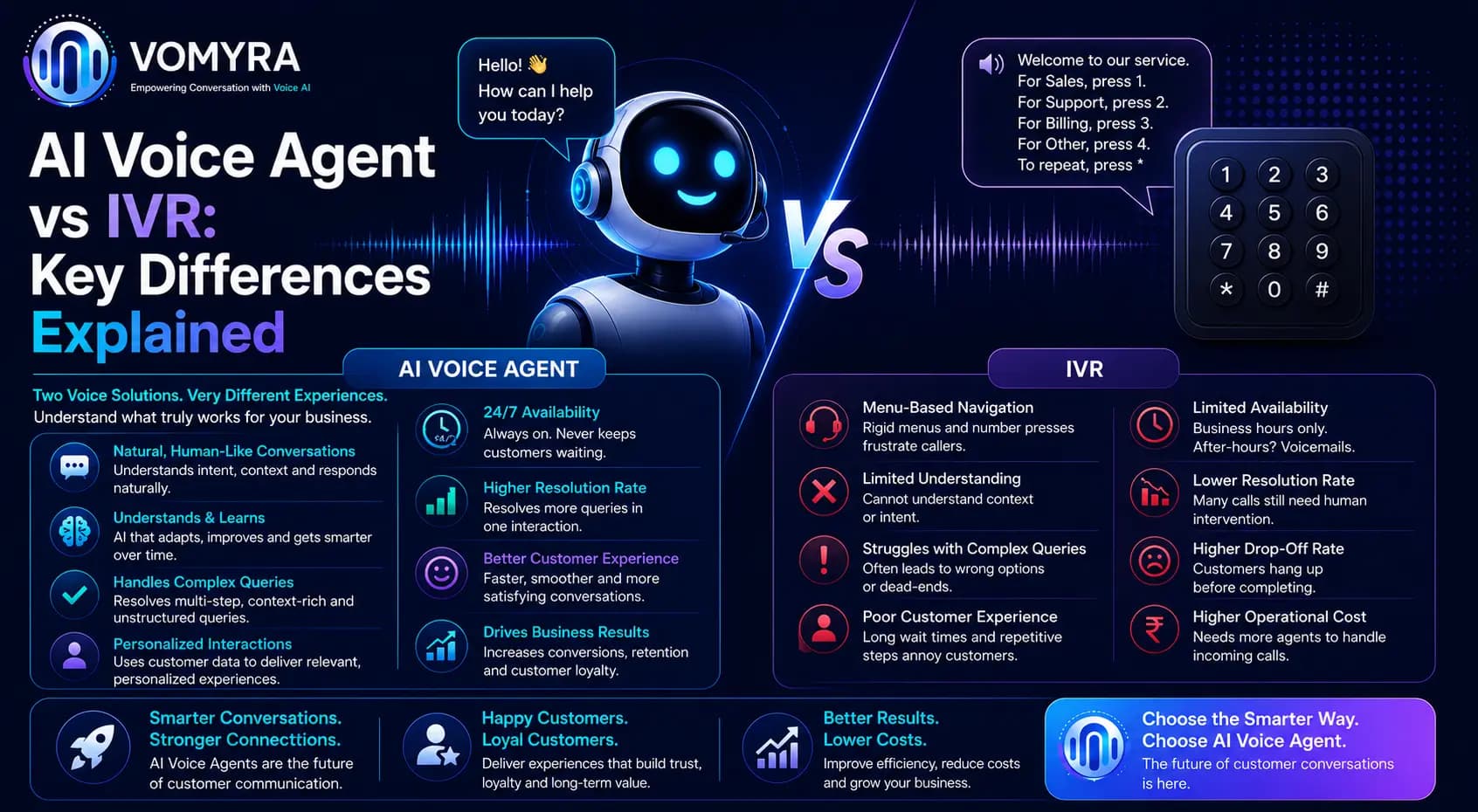
AI Voice Agent vs IVR: The Core Differences
1. How They Understand You
IVR systems understand button presses or a very limited set of pre-programmed keywords. Say something outside that list, and it simply won’t understand.
AI voice agents use natural language understanding. They can interpret full sentences, slang, accents, and even incomplete thoughts, then respond appropriately. This is the single biggest difference between the two.
2. Conversation Flow
With IVR, the conversation is one-directional and scripted. You listen, you press a button, you wait. There’s no real back-and-forth.
With an AI voice agent, the interaction feels like an actual conversation. Customers can ask questions mid-flow, change their mind, or ask something unrelated, and the system adapts instead of breaking down.
3. Personalization
IVR treats every caller the same way, offering the same fixed menu regardless of who’s calling. AI voice agents can pull customer data, recognize returning callers, and tailor responses based on account history or previous interactions.
4. Handling Complex Queries
IVR is great for simple routing: “press 1 for sales, press 2 for support.” But the moment a query gets complicated, it usually routes to a human agent anyway, adding delay and frustration.
AI voice agents are designed to handle multi-step, complex conversations on their own, only escalating to a human when truly necessary. This alone reduces wait times significantly for businesses that adopt it.
5. Setup and Flexibility
IVR menus are rigid once built. Updating them usually requires technical changes and re-recording prompts.
AI voice agents are far more flexible. Businesses can update responses, add new use cases, or retrain the AI voice agent to handle new scenarios without ripping apart the entire system. If you want to see how this flexibility works in practice, you can check out how Vomyra builds custom AI voice agents tailored to different industries.
6. Customer Experience
This is where the gap is widest. IVR often frustrates customers, especially when they’re stuck in a loop or transferred repeatedly. It feels robotic because, well, it is.
AI voice agents feel closer to talking with a knowledgeable staff member. They’re patient, quick, and don’t make callers repeat themselves. For businesses, this translates directly into better customer satisfaction scores and fewer abandoned calls.
Cost Considerations
IVR systems are generally cheaper to set up initially since the technology is older and simpler. But the hidden cost comes later: more calls get escalated to human agents, increasing staffing needs and call center costs.
AI voice agents may have a slightly higher upfront investment, but they cut down on human agent workload significantly by resolving more queries automatically. Over time, this usually results in lower overall costs, not higher ones.
Which One Should Your Business Use?
Here’s the honest answer: it depends on your call volume and complexity.
- If your business only deals with very simple, predictable call routing (like directing calls to different departments), a basic IVR might still work.
- If your business handles customer support, bookings, order tracking, or any query that varies from caller to caller, an AI voice agent is the smarter long-term choice.
Many businesses are also combining both- using AI voice agents as the primary interface, with IVR-style fallback options for very specific, simple requests. This hybrid approach is becoming increasingly common as companies transition away from outdated phone systems.
Real-World Impact
Companies that switch from traditional IVR to AI voice agents typically report:
- Shorter average call handling time
- Fewer dropped or abandoned calls
- Higher first-call resolution rates
- Better customer satisfaction scores
- Reduced load on human support teams
These aren’t just marketing claims, they reflect how much friction is removed when customers can simply talk instead of navigating a maze of button presses.
The Future Is Conversational
Customer expectations have changed. People are used to talking naturally to Alexa, Siri, and chatbots. Expecting them to press buttons and listen to a robotic menu feels outdated, and it shows in customer satisfaction data across industries.
The shift toward conversational AI phone systems isn’t just a trend, it’s becoming the standard. Businesses that stick with old-school IVR risk falling behind competitors who offer a smoother, faster, more human-like calling experience.
If you’re exploring how to modernize your business’s phone support, it’s worth learning more about how Vomyra’s AI voice agents are helping companies replace outdated IVR systems with something customers actually enjoy interacting with.
Final Thoughts
The AI voice agent vs IVR debate really comes down to one thing: how much value you place on the caller’s experience. IVR gets the job done in a very basic way, but it wasn’t built for today’s expectations. AI voice agents, on the other hand, offer a natural, efficient, and scalable way to handle customer calls without making people feel like they’re talking to a machine (even though, technically, they are).
As more businesses adopt this technology, the gap between companies using AI voice agents and those still relying on outdated IVR menus will only get wider, especially in industries where fast, accurate customer service is a competitive advantage.
FAQs
1. Is an AI voice agent more expensive than IVR?
Initial setup can cost slightly more, but AI voice agents usually save money over time by reducing human agent workload.
2. Can AI voice agents replace human agents completely?
Not entirely. They handle most queries automatically but still escalate complex issues to humans when needed.
3. Do customers prefer AI voice agents over IVR?
Generally, yes. Natural conversation feels faster and less frustrating than pressing buttons through menus.
4. Can IVR and AI voice agents work together?
Yes, many businesses use a hybrid setup, combining AI voice agents with simple IVR fallback options.
5. Is AI voice agent technology suitable for small businesses?
Yes, it scales well for both small businesses and large enterprises depending on call volume and needs.